
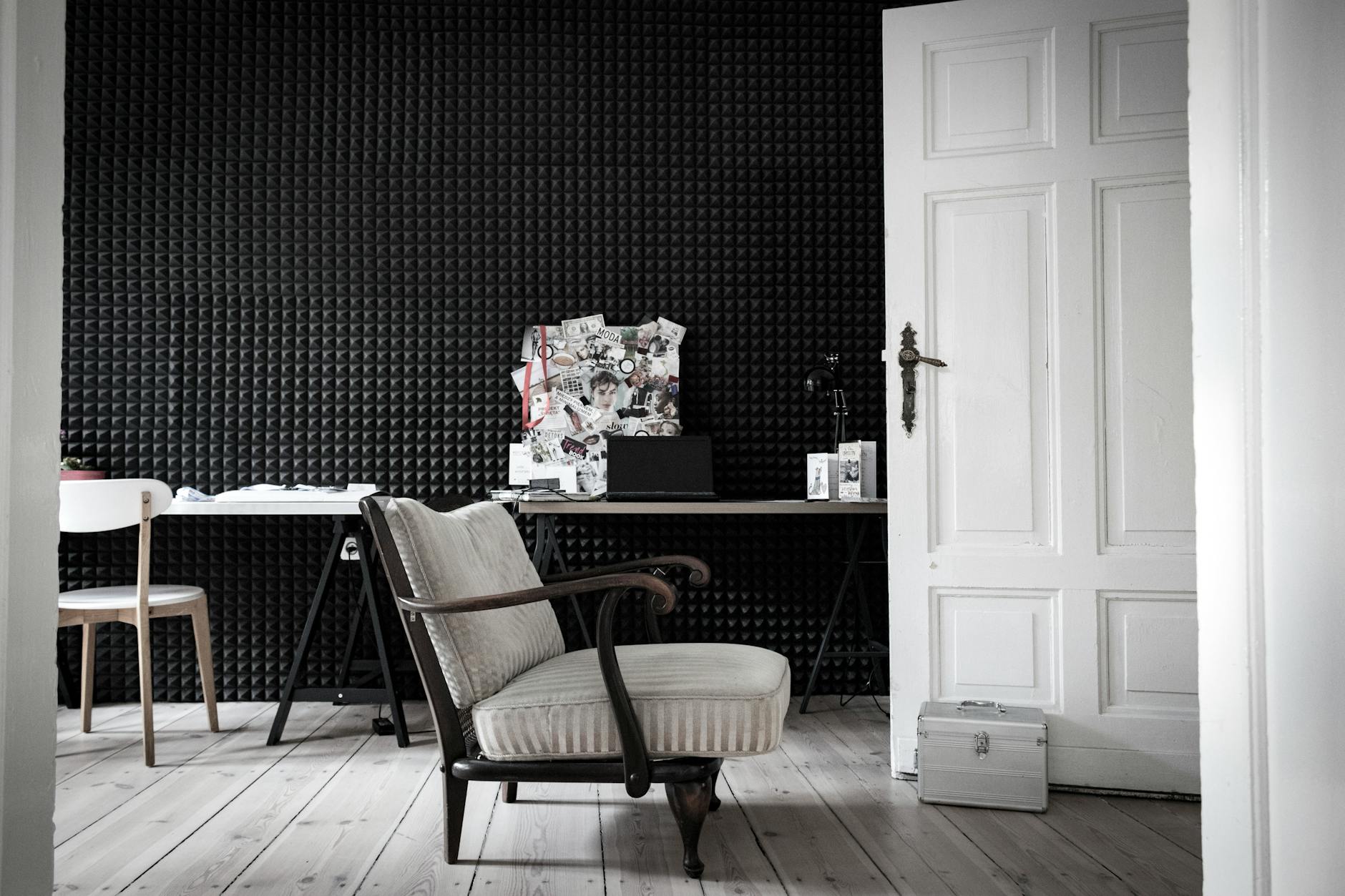
Engineering Your Personal Acoustic Environment
Creating a truly focused workspace requires more than just aesthetic choices; it necessitates an understanding of how sound transmission operates within your physical space. We are not simply decorating walls; we are manipulating physics to control auditory input. The goal when designing a soundproof home office is to manage both airborne noise and impact vibrations, ensuring the environment supports deep concentration rather than creating new distractions.
Deconstructing Noise Transmission Pathways
Sound travels through three primary mechanisms: airborne sound, impact sound, and flanking transmission. Airborne sound occurs when sound waves travel through the air, which requires barriers with sufficient mass and density to impede their passage effectively. Impact sound involves vibrations transmitted directly through solid structures, such as floors or shared walls. Flanking transmission happens when sound bypasses direct barriers by exploiting structural weaknesses, like gaps in drywall or poorly sealed door frames. Understanding these pathways allows us to target solutions precisely.
When we focus on acoustic isolation for a home office nook, the mass-spring-mass system becomes our primary tool. To effectively block airborne noise, we need substantial, dense materials installed between the source of the noise and the desired workspace. Thin gypsum board alone provides minimal attenuation when dealing with consistent high-frequency sounds from neighboring rooms or traffic outside. We must introduce layers of decoupled material to disrupt the vibrational energy before it enters the room.
Material Science for Acoustic Barriers
The selection of materials dictates the success of any soundproofing endeavor. Mass is directly correlated with sound blocking capability; heavier materials absorb and reflect more energy. For instance, adding multiple layers of dense drywall, perhaps incorporating specialized acoustic insulation materials between them, increases the overall Sound Transmission Class (STC) rating of a wall assembly. We observe that layering different densities creates a superior dampening effect compared to relying on a single thick layer.
Decoupling is another critical mechanism we must employ. Simply adding mass to a vibrating surface is insufficient if the structure remains rigidly connected across the entire span. Decoupled systems utilize resilient channels or isolation mounts, preventing vibration energy from transferring directly between adjacent structural elements. This separation breaks the vibrational chain that allows noise to resonate through the building envelope. In practice, this often involves creating an air gap filled with acoustic sealant or specialized resilient mats.
Optimizing the Home Office Nook Design
The physical placement of your workspace dramatically influences its acoustic performance. Positioning the desk against a shared wall necessitates the most aggressive soundproofing measures because that wall is the primary transmission source. We must prioritize sealing and mass application on this specific boundary first.
Consider the door system, often the weakest link in any room’s acoustic profile. Standard hollow-core doors offer very little resistance to sound transmission. Upgrading to solid-core doors significantly increases the physical barrier. Equally important is treating the perimeter of the door frame. Sealing all gaps around the door jamb with high-density acoustic caulk eliminates flanking paths where sound can easily leak through minuscule openings. This meticulous attention to sealing prevents noise from finding unintended routes.
When designing the aesthetic of this sanctuary, the choice of interior materials plays a subtle but significant role in overall auditory perception. Soft furnishings absorb reverberation within the room, which reduces the perceived intensity of any remaining sounds. Integrating textiles, like heavy drapery or area rugs, helps manage the soundscape internally. This aligns with the principles observed when seeking an atmosphere aligned with The Art of Hygge: Simple Ways to Create Cozy Home Vibes. A highly insulated space feels inherently calmer, regardless of external noise levels.
Controlling Interior Acoustics and Visual Perception
Soundproofing addresses stopping sound from entering or leaving; interior acoustic treatment manages how sound behaves within the space. Reflections off hard, flat surfaces create echo and increase background noise, making concentration more difficult. To mitigate this internal reverberation, we introduce porous, absorptive materials strategically.
Wall panels made of felt or specialized acoustic foam are excellent at trapping mid-to-high frequency reflections. Placing these strategically on walls facing the desk helps manage the sound environment directly around the user. This is about managing the room’s internal acoustics rather than just blocking external noise. The goal is to reduce the overall noise floor experienced by the occupant.
The color palette also influences this perception. Deep, saturated colors naturally absorb more light and create a visually dense, enveloping atmosphere. We see that incorporating Moody Jewel Tones: Mastering Deep Colors for Cozy Interiors assists in creating an environment where visual focus is enhanced, indirectly supporting mental focus. Darker tones tend to reduce visual distraction while enhancing the feeling of enclosure and coziness.
Implementing Layered Solutions Systematically
Achieving optimal sound isolation requires a layered approach, addressing each failure point sequentially. We start with sealing air gaps wherever possible; this addresses flanking noise immediately. Next, we address structural mass by installing dense barriers on shared walls. Then, we manage the internal space through absorption. This systematic process ensures that resources are allocated to where the physical limitations are most severe.
When installing heavier acoustic panels, ensure they are mounted using appropriate resilient hardware to maintain the decoupling effect. Avoid mounting heavy materials directly onto existing studs if possible; utilize specialized framing techniques that incorporate air gaps behind the paneling for maximum isolation efficiency. The process demands an engineering mindset applied to interior design choices. We must treat the room as a system where every component interacts acoustically.
The investment in a soundproof home office is not merely an expense for materials. It represents an investment in cognitive performance and long-term well-being. By systematically engineering the physical environment, we are actively controlling sensory input. The result is a dedicated sanctuary where concentration can flourish unhindered by external auditory intrusions.
Tags: soundproof home office, cozy workspace, home office design, acoustic comfort, soundproofing tips, cozy decor, workspace setup
Featured Image by Mateusz Dach on Pexels.